
Barriers to thermal storage deployment: Lessons from the HYSTORE Project
This study outlines a socio-technical approach within the Horizon Europe HYSTORE project to accelerate the deployment of thermal energy storage (TES) technologies. Combining co-creation stakeholder engagement across three European pilot locations with qualitative content analysis, the research identifies critical technical, economic, usability, regulatory, and environmental deployment barriers. The findings yield a structured workflow translating social science insights into actionable engineering requirements and design guidelines, ensuring advanced TES solutions achieve both technical performance and real-world adoption.
Do you want to know more?
Join us at ENLIT 2026 in Wien! More information here
Thermal energy storage (TES) is increasingly recognised as an enabling technology for the decarbonisation of buildings, district energy systems and industrial processes. By decoupling heat generation from heat demand, TES can increase renewable-energy utilisation, support demand-side flexibility and improve the operation of heat pumps and thermal networks.
However, the deployment of advanced TES technologies remains slower than their technical potential would suggest. In addition to material, component and system-level challenges, adoption is influenced by economic constraints, regulatory uncertainty, perceived complexity, environmental concerns and the degree to which new solutions can be integrated into existing buildings and practices.
These dimensions are particularly relevant for latent heat storage using phase change materials (PCMs) and thermochemical storage (TCM), which offer high storage density but are generally less mature and more complex than conventional sensible heat storage.
This work presents a socio-technical approach developed within the Horizon Europe HYSTORE project, which develops and demonstrates several TES solutions for residential, tertiary and district-energy applications.
The project includes:
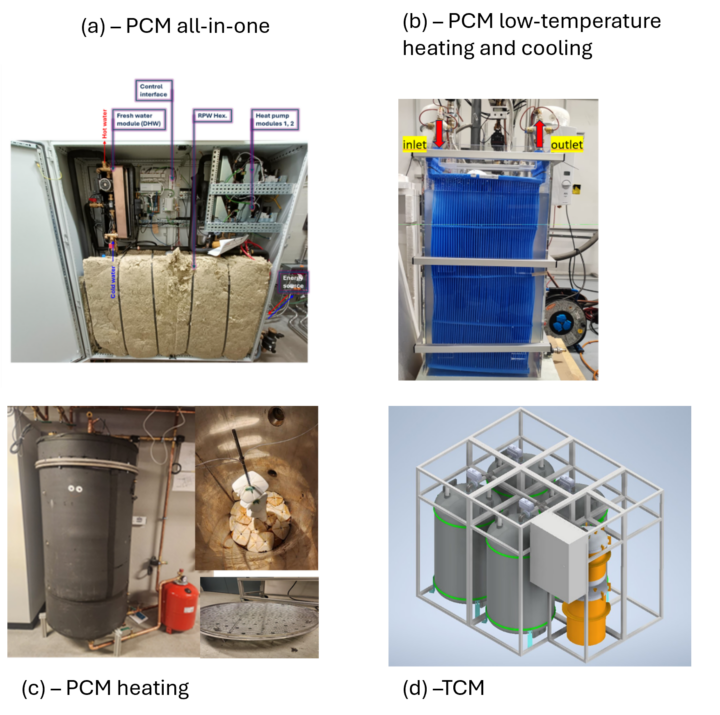
- compact PCM systems for domestic hot water (PCM-all-in-one),
- modular low-temperature heating and cooling storage (PCM low-temperature heating and cooling),
- PCM storage integrated with heat pumps and supervisory control (PCM heating), and a
- modular zeolite-based thermochemical storage system able to provide heating and cooling (TCM).
These technologies are demonstrated in different European contexts, providing a practical basis for investigating not only technical performance but also stakeholder expectations, perceived barriers and conditions for adoption. An overview of the developed prototypes is given in Figure 1.
Stakeholder engagement and methodological approach
The Social Sciences and Humanities (SSH) activities were designed to complement the engineering development through participatory methods based on co-creation and mutual learning. Engagement activities were conducted at three HYSTORE pilot locations: Dublin in Ireland, Langenwang in Austria and the Montserrat massif in Spain.
The formats were adapted to the local context and included an online discussion on thermochemical storage, an in-person laboratory session focused on the PCM All-in-One prototype, and a World Café-inspired workshop with technical and non-technical stakeholders. Participants included researchers, engineers, students, building managers and potential technology users. The discussions addressed technology scale-up, costs, policy incentives, installation, integration, usability, environmental impacts and regulatory requirements.
The collected material was analysed through qualitative content analysis. Open coding was first used to capture concepts expressed by participants in their own terms. These codes were then grouped into higher-order themes.
Five recurring dimensions were identified:
- technical,
- environmental,
- regulatory,
- economic
- usability.
This structure provides a useful way to interpret the barriers to TES deployment because it connects issues that are often treated separately in purely technical or market-oriented analyses.
Main barriers to TES deployment
Technical discussions highlighted the importance of integration with existing infrastructure, system dimensions, maintenance, temperature management, peak-demand management and plug-and-play installation. Across the three engagement activities, participants repeatedly raised the need to reduce prototype size, weight and spatial requirements. In addition, stakeholders stressed that the successful adoption of a TES solution may depend on the modifications required to existing buildings and thermal systems.
These observations are especially relevant for advanced storage technologies because performance improvements at material level do not necessarily translate into straightforward deployment at system level.
Economic barriers emerged as one of the strongest common concerns. Participants referred to high upfront investment, CAPEX and OPEX, uncertainty regarding return on investment and the possible need for public incentives during early market deployment. Demand response and time-of-use electricity tariffs were discussed as mechanisms that could improve the value proposition of TES by enabling charging during low-cost periods and discharging during periods of high demand or high electricity prices.
The results therefore suggest that economic performance should be considered together with system control and operation, rather than treated only as a final techno-economic assessment.
Usability was the second major cross-cutting issue. Stakeholders associated complex installation, commissioning and operation with lower acceptance, particularly when technical expertise is required from end users. Participants called for clearer comparisons with conventional alternatives, easier integration with existing systems, understandable information on operating conditions and more automated control. At the Austrian pilot, participants expressed a preference for fully automated operation rather than manual management. This indicates that control-system design, user interfaces, diagnostics and commissioning procedures can directly affect the perceived value of a TES technology.
Regulatory uncertainty and administrative complexity also appeared as relevant barriers. Participants highlighted the need for standardisation, clearer safety requirements, alignment with building and environmental certification schemes, and documentation supporting long-term reliability.
Environmental aspects included material toxicity, waste generation, lifecycle carbon footprint, recyclability and the use of greener materials. Although environmental concerns were not equally prominent in all meetings, they reinforce the need to consider lifecycle performance from the early design stage.
From stakeholder evidence to engineering requirements
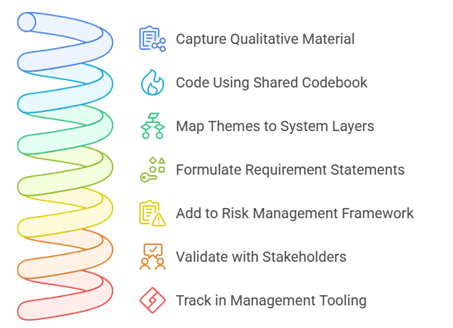
A key contribution of HYSTORE is the proposed workflow for translating SSH findings into engineering requirements, following the methodology shown in Figure 2. Stakeholder evidence is first captured and coded using a common framework. The resulting themes are then mapped onto relevant system layers and reformulated as technical or design requirements using controlled language. These requirements can subsequently be integrated into the project risk-management process, validated with representative stakeholders and tracked using requirements-management tools. This creates traceability between stakeholder concerns, engineering decisions and verification activities.
Based on the recurring themes, the study derives practical design guidelines. TES solutions should be modular and as close as possible to plug-and-play, with standardised hydraulic and electrical interfaces.
Safety information should be accessible, while reliability can be supported through diagnostics, predictive maintenance and clear service pathways.
Environmental targets should be defined early through lifecycle-based indicators and appropriate certification documentation.
Cost reduction should be pursued through standardisation, manufacturability and control strategies that unlock clear operational value streams.
Finally, compliance matrices and permitting-ready documentation should be developed alongside the technology rather than after prototype completion.
Conclusions
The HYSTORE experience demonstrates that SSH methods can provide actionable inputs for technology development when they are explicitly connected to engineering processes. For TES, barriers such as cost, usability, regulatory uncertainty and integration constraints are not peripheral to technical design; they influence whether technically promising solutions can be adopted in real buildings and energy systems. Embedding stakeholder evidence into requirements-based development therefore offers a practical pathway towards more robust, acceptable and deployable thermal energy storage technologies.

Valeria Palomba
CNR Institute for Advanced Energy Technologies (CNR-ITAE), Messina, Italy
Valeria Palomba is a researcher at CNR ITAE in Messina, Italy. She holds a Masters’ Degree in Materials Engineering and a PhD in Materials and Buildings Science and Engineering. She is currently responsible for CNR for 2 Horizon Europe projects and has been involved in 10+ projects.